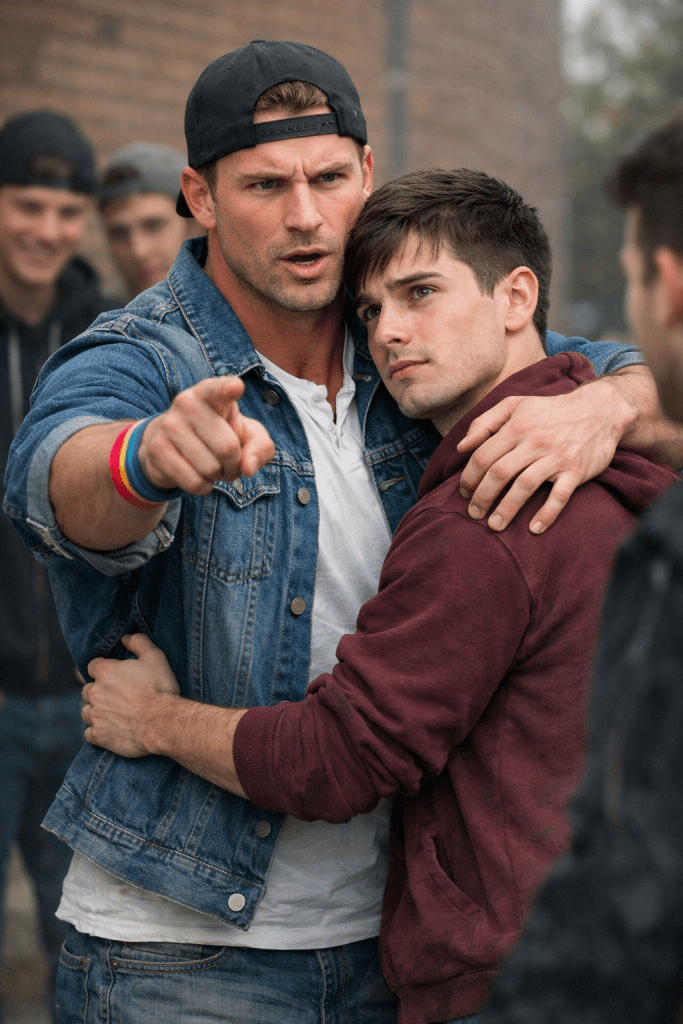
When I think about the kinds of men I want to write about, I don’t think only about labels. I think about the lives they might lead, the people they might become, the friendships they might build, and the things they might struggle to say out loud.
My interest in pan-flexible men comes from a creative desire to explore possibilities. What would it look like to create male characters who could be confident without being arrogant, protective without being controlling, affectionate without feeling embarrassed, and uncertain without believing that uncertainty makes them weak?
Those are the kinds of questions I want to explore through my writing.
Men Who Are More Than One Thing
I don’t want every male character in my stories to feel as though he came from the same blueprint. One man might be outgoing and comfortable discussing his identity. Another might be private, thoughtful, and still trying to understand himself. A third might have a strong sense of who he is but struggle to communicate his feelings to the people he cares about.
Some characters might identify as pansexual, panromantic, or pan-flexible. Others might be questioning. Some might be straight characters whom readers interpret as pan-coded because of their personalities, relationships, or the way the story presents them.
These characters don’t all need to reach the same conclusion.
I want readers to encounter different possibilities rather than one supposedly perfect example of what a pan-flexible man should be.
After all, a person’s identity is only one part of his life. His humor, fears, ambitions, mistakes, loyalties, relationships, and personal history matter, too.
The Kind of Masculinity That Interests Me
One of the themes I want to explore is a masculinity that makes room for tenderness.
I am interested in men who can be strong while admitting that something hurts. Men who can protect someone without deciding everything for them. Men who can express affection without treating it as an embarrassment. Men who can apologize, ask for help, and recognize when they have made a mistake.
I don’t believe every man has to express masculinity in the same way. Some men are naturally expressive, while others show their care through quiet gestures and consistent actions. Neither approach automatically makes someone more authentic than the other.
What interests me is the freedom for men to be themselves without constantly worrying about whether their behavior meets somebody else’s expectations.
And I don’t want tenderness to become another requirement. A man can be gentle, reserved, energetic, serious, playful, or a combination of many qualities. His personality doesn’t prove his orientation, and his orientation doesn’t dictate his personality.
That distinction matters to me as a writer.
Friendship, Brotherhood, and Belonging
Romantic relationships aren’t the only relationships worth exploring.
I want to write about male friendships that develop through trust, shared experiences, humor, and mutual understanding. I want to explore brotherhood between men who aren’t related by blood, including friendships in which one person becomes a mentor, a dependable older-brother figure, or simply someone who makes another person feel less alone.
Sometimes, the most meaningful thing one man can say to another is, “I’m here if you need me.”
That sentence doesn’t have to carry a romantic or sexual meaning. It can represent friendship, loyalty, compassion, and the decision to show up when someone needs support.
I want to give those connections room to grow naturally in my stories. Two men can care deeply about each other without the narrative needing to turn their relationship into a romance. At the same time, other characters might discover romantic feelings that they didn’t expect. Both possibilities deserve thoughtful storytelling.
The important thing is allowing each relationship to become what it is rather than forcing every connection into the same category.
Characters Who Are Still Becoming Themselves
I also want to make room for characters who don’t have all the answers.
Someone might begin a story with a label that feels right and later discover that another description fits better. Someone else might prefer not to use a label at all. Another character might understand his feelings but struggle with how to communicate them to his friends or family.
These experiences don’t need to be treated as failures or dramatic revelations every time. Sometimes understanding yourself is gradual. Sometimes a person simply learns more about what he wants, what he values, and what kind of relationships make him feel comfortable.
I want to approach those experiences with curiosity rather than judgment.
Readers should be able to see a character questioning something without assuming that he is confused about everything. They should also be able to interpret a character differently from the way I intended, provided we remember that interpretation isn’t the same as establishing someone’s identity.
That balance between authorial intention and reader interpretation is part of what makes writing interesting to me.
Why This Matters to My Five-Novel Vision
As I continue developing my ideas for The Pan-curious Journey, I want to build a world that can accommodate many kinds of men and many kinds of relationships.
Across five novels, I can explore different personalities, backgrounds, friendships, romantic possibilities, and approaches to identity without expecting one character to represent everybody.
One story might focus on a man learning to express himself. Another might explore a friendship that becomes an important source of stability. A different story could follow someone navigating attraction and uncertainty, while another examines how assumptions about masculinity affect the way men treat one another.
These stories can connect through shared themes without repeating the same character arc.
I want the characters to have their own voices, their own contradictions, and their own reasons for making the choices they make. I want them to be capable of getting things wrong and learning from those experiences. Most importantly, I want them to feel like people rather than examples in an argument.
The Stories I Hope to Create
Ultimately, I want to write stories that leave room for possibility.
Possibility for men who are comfortable with their identities and men who are still exploring them. Possibility for masculinity that includes emotional openness without demanding it from everyone. Possibility for friendships that offer genuine belonging, romantic relationships that develop at their own pace, and characters who don’t fit neatly into other people’s expectations.
I don’t need every reader to interpret every character exactly as I do. I hope readers will find something meaningful in the stories, whether that means recognizing themselves, understanding someone else’s perspective, or simply discovering a character they want to know better.
For me, writing about pan-flexible men is not about proving that all men are alike. It’s about making space for their differences.
And perhaps that’s the heart of The Pan-curious Journey: not telling readers who these men must be, but inviting them to discover who each man becomes.